


MODULE 2. Core Content – Knowledge Base (Trainer Background)
Why do young people pick up their devices even when they don’t actually want to?
Why does scrolling feel effortless, but stopping feels difficult?
And why do certain apps seem to have a hold on them?
This module helps youth workers understand the psychology underneath digital habits — the emotions, needs, and inner processes that make screens appealing, comforting, or compelling. When we understand what’s driving behaviour, we can support young people without judgment and help them build awareness, agency, and healthier coping strategies.
This module builds directly on Module 1, but goes deeper into motivation, emotion, reward, and triggers.
Learning Objectives & Expected Outcomes
By the end of this module, you will be able to:
- Explain the digital reward cycle in clear, accessible language.
- Identify emotional, social, and psychological triggers behind screen use.
- Interpret early warning signs of problematic or compulsive digital habits.
- Use tools like the Feelings Wheel, Trigger Map, and Digital Needs prompts to facilitate emotional awareness.
- Support young people in recognising why they turn to screens and what they may be seeking underneath (connection, escape, reassurance, stimulation, etc.).
Module Overview – What This Module Covers
In this module, we’ll explore:
- How reward systems shape digital habits.
- Common emotional drivers such as boredom, anxiety, loneliness, stress, and FOMO.
- How social pressures influence behaviour (validation loops, comparison, belonging).
- Spotting early red flags in behaviour, language, and mood.
- Why some young people are more vulnerable than others.
- Simple, evidence-informed tools youth workers can use to help young people connect feelings → needs → digital behaviour.
Core Content – Knowledge Base (Trainer Background)
What’s Really Driving Digital Behaviour?
Young people rarely scroll “just because.” Their digital behaviour is shaped by:
- Emotional needs (comfort, distraction, connection, stimulation)
- Social dynamics (belonging, validation, fear of missing out)
- Internal habits (automaticity, boredom-avoidance)
- Platform design (rewards, notifications, unpredictability)
Understanding these drivers helps us support youth without moral judgment — and opens the door to honest conversations.
The Reward Cycle: Why Screens Feel So Good (at first)
Our brains are wired to pay attention to novelty, rewards, and social cues.
When young people see:
- a new notification
- a funny video
- a message
- a like or reaction
- the next episode, automatically queued
their brain sends a small dopamine signal — a “pay attention” message.
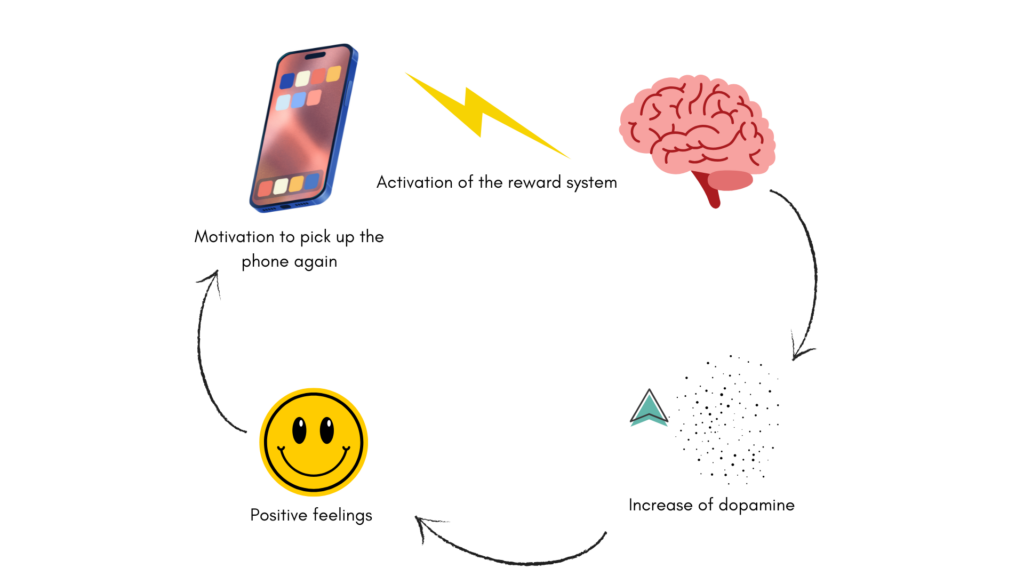
The cycle looks like this:
- Trigger → Something captures attention.
- Dopamine anticipation → Brain expects pleasure, connection, or relief.
- Behaviour → Youth open the app/scroll/check.
- Reward → The content delivers novelty, amusement, or connection.
- Memory → Brain links the behaviour with temporary relief or pleasure.
- Repeat → The loop becomes automatic.
Why this matters:
This loop is powerful even for adults — and young people’s developing brains are especially sensitive to these rewards.
Emotional Drivers: Why Screens Are a Shortcut to Relief
Screens provide quick emotional relief. That’s part of why they’re so compelling.
Young people often turn to screens when they feel:
- Bored → screens offer instant stimulation
- Stressed → screens distract from discomfort
- Lonely → screens offer social contact
- Anxious or overwhelmed → screens numb or soothe
- Sad or low-energy → screens give a temporary “lift”
- Avoidant → screens postpone tasks or emotions
But the relief is temporary, and the underlying feeling remains unaddressed.
This pattern is known as compulsive digital use, and it’s one of the most common challenges youth workers observe.
Social Pressure, Comparison & FOMO
Digital spaces are also social spaces — which means young people feel:
- Validation pressure. Likes, comments, shares, streaks = evidence of social acceptance.
- Comparison pressure. They compare their real life to others’ curated online moments.
- Belonging pressure. If friends are online, they must be too.
- Fear of being left out, missing an event, or falling behind.
These pressures can increase anxiety, lower self-esteem, and keep young people online even when they feel drained.
Warning Signs of Problematic Digital Use
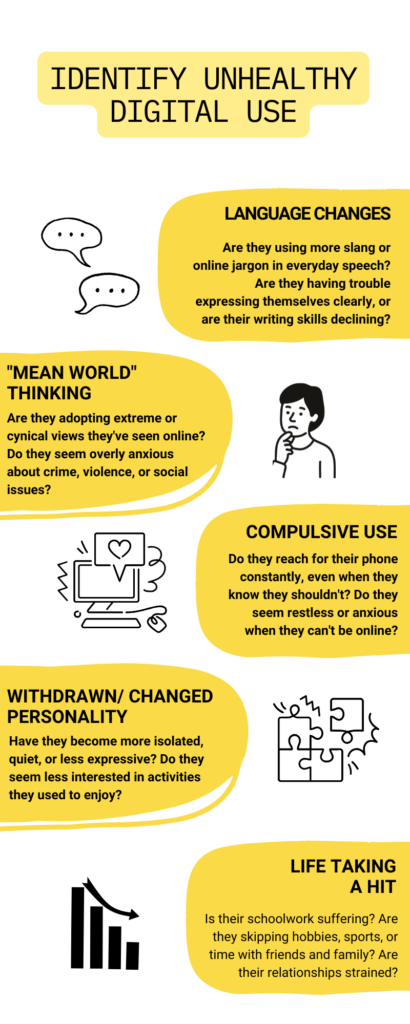
Youth workers often notice early changes before young people do.
Emotional signs
- irritability or restlessness when offline
- mood drops after scrolling
- feeling overwhelmed or pressured online
Behavioural signs
- automatic phone grabbing
- checking repeatedly for no clear reason
- difficulty stopping
- avoiding tasks or emotions
Social signs
- withdrawing from offline relationships
- overthinking likes, messages, or online interactions
- preoccupation with online identity
Language signs
- increasingly negative worldview (“everyone is awful,” “the world is dangerous”)
- difficulty expressing emotions without emojis or memes
- adopting extreme opinions or conspiracy narratives
Patterns matter more than individual moments.
Why Some Young People Are More Vulnerable
Several factors increase risk:
- Emotional vulnerability. Young people who experience anxiety, stress, loneliness, low mood, or low self-esteem may rely more heavily on screens for relief.
- Developmental stage. Adolescence involves identity formation, peer comparison, and increased social sensitivity — all amplified by digital environments.
- Household dynamics. High conflict, low communication, or unclear expectations can push youth toward digital escape.
- Personality traits. Youth who are sensitive, impulsive, perfectionistic, or easily overstimulated may be at higher risk.
- Environmental factors. School pressure, social isolation, lack of offline hobbies, or family digital habits also shape use.
Understanding these factors supports compassionate, non-judgmental conversations.
Tools for Emotional Awareness
- Feelings Wheel (Digital Well-being Edition)
Helps youth identify and name emotions with more precision.
How to use it:
- Ask: “What were you feeling before you reached for your phone? During? After?”
- Invite youth to pick emotions from the inner circle first, then refine.
- Connect feelings to needs (connection, rest, stimulation, reassurance).
- Trigger Map
A simple map that helps youth connect:
Trigger → Emotion → Behaviour → Consequence → Alternative
Example:
Trigger: Bored in class
Emotion: Restless
Behaviour: Scrolling TikTok
Consequence: Feels more distracted
Alternative: Doodling, stretching, note-taking hack
- Digital Needs Prompts
Short prompts that help uncover needs behind behaviour:
- “When I scroll late at night, I’m actually looking for…”
- “When I play games for hours, I might need…”
- “When I post online, what I really want is…”
Youth quickly realise their digital habits are attempts to meet valid underlying needs.
Why This Helps
Naming emotions increases control. When youth can name feelings, they can respond intentionally instead of reacting automatically.
Understanding triggers reduces shame. Young people realise “It’s not just me — there’s a reason I do this.”
Needs mapping builds healthier alternatives. Once youth identify the need (e.g., connection), they can find other ways to meet it.