


MODULE 1.Core Content – Knowledge Base (Trainer Background)
Young people are growing up in a world where screens are woven into almost everything they do — connecting, relaxing, learning, creating, escaping, and figuring out who they are. As youth workers, you’re not here to police their tech use. You’re here to understand what’s happening beneath the surface and guide them in building digital habits that support their wellbeing rather than drain it.
This module gives you a clear foundation to understand what digital well-being actually means, why screens feel so irresistible, and what early signs of struggle look like — so you can support young people with confidence, empathy, and practical insight.
Learning Objectives & Expected Outcomes
By the end of this module, you will be able to:
- Explain digital well-being in simple, relatable language that resonates with young people.
- Identify psychological, social, and environmental reasons why screens are so compelling.
- Recognise early behavioural, emotional, and social signs of unhealthy or compulsive digital use.
- Understand how design features (scrolling, notifications, likes, rewards) influence habits.
- Use up-to-date research to inform conversations and promote healthy digital awareness.
Module Overview – What This Module Covers
In this module, you will explore:
- What digital well-being is and why it matters in youth work.
- How young people develop digital habits — and what drives these behaviours.
- Why screens are hard to put down, including boredom, emotional triggers, and design tricks.
- How compulsive digital use develops, and the difference between compulsive use and addiction.
- Early signs that digital habits may be affecting a young person’s wellbeing.
- Key statistics and trends to help you ground your work in evidence.
Core Content – Knowledge Base (Trainer Background)
What Is Digital Well-being?
Digital well-being is the ability to maintain a healthy relationship with technology — one that supports a young person’s mental, emotional, social, and physical health.
It’s not only about how much time they spend online, but:
- why they use screens
- how their digital habits make them feel
- whether technology adds to or takes away from their wellbeing
- how easily they can disconnect and stay balanced
For youth workers, digital well-being means recognising when tech supports growth and connection … and when it starts interfering with sleep, mood, learning, relationships, and overall balance.
When Digital Use Becomes Unhelpful
Most young people use screens for enjoyment, connection, creativity, or information. But digital use becomes problematic when:
- it shifts from a choice to a compulsion,
- it becomes the default response to stress, boredom, or difficult feelings,
- it interferes with daily functioning or relationships,
- they feel unable to stop even when they want to.
Addiction vs. Compulsion
Using clinical terms like “addiction” can be misleading and often shuts conversations down. A more accurate and helpful distinction is:
- Addiction: Chasing a rewarding feeling again and again.
- Compulsion: Using screens to avoid uncomfortable feelings (boredom, loneliness, stress, anxiety).
Most young people experiencing difficulties with digital use fall into the compulsive pattern rather than the addictive one.
Boredom: A Powerful Driver of Screen Use

Boredom is uncomfortable. It creates restlessness and a sense of “not knowing what to do.” Because screens offer instant stimulation, many young people use them to avoid that feeling.
But avoiding boredom repeatedly:
- reduces tolerance for stillness,
- interrupts opportunities for creativity, imagination, or social interaction,
- increases the automatic pull toward the phone.
Helping young people redefine boredom as a signal, not a problem, can be transformative. This expands naturally into Module 2’s focus on emotions and triggers.
How Screens Are Designed to Keep Us Hooked
Apps and platforms are built using techniques that keep users engaged for as long as possible. Understanding these helps young people see that struggling to disconnect is not a personal failure — it’s the result of intentional design.
Common persuasive design elements:
- Infinite scroll: No natural stopping point.
- Autoplay: New content starts before they can pause.
- Likes & reactions: Provide unpredictable dopamine rewards.
- Notifications: Interrupt attention and stimulate curiosity or urgency.
- Streaks: Create social pressure and fear of loss.
Why it matters for youth
Young people’s brains are still developing, especially the parts responsible for:
- impulse control
- long-term planning
- emotional regulation
This makes them more sensitive to reward patterns — and more vulnerable to persuasive digital design.
The Real Impacts on Youth
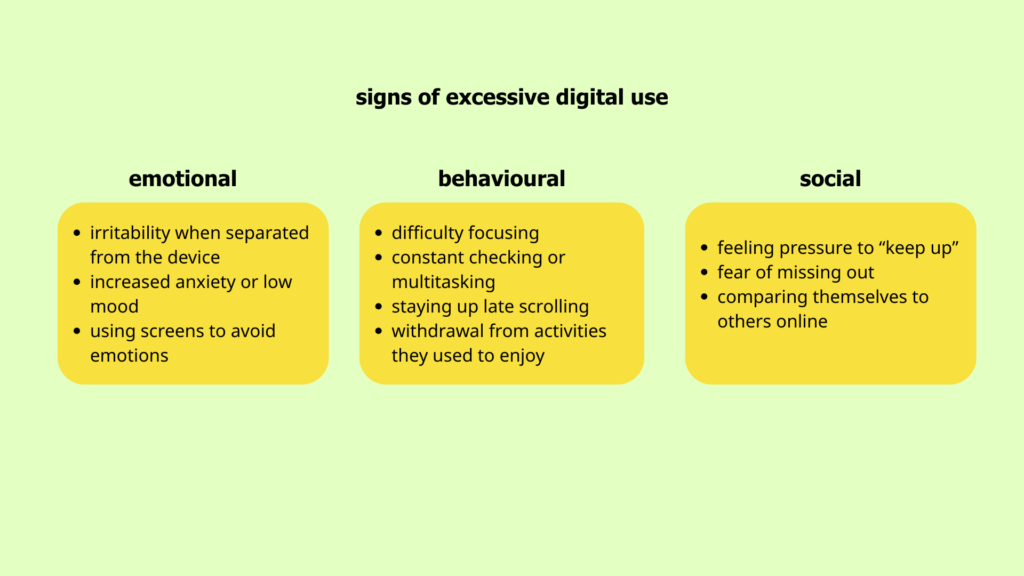
Compulsive or excessive digital use can show up in many ways, including:
Emotional signs
- irritability when separated from the device
- increased anxiety or low mood
- using screens to avoid emotions
Behavioural signs
- difficulty focusing
- constant checking or multitasking
- staying up late scrolling
- withdrawal from activities they used to enjoy
Social signs
- feeling pressure to “keep up”
- fear of missing out
- comparing themselves to others online
Not all signs mean a young person is struggling — but a pattern across several of these areas may signal that support is needed.
What Is Mindfulness — and Why Does It Matter for Digital Well-being?
Youth-friendly definition:
Mindfulness is noticing what is happening right now — in your body, your thoughts, and your surroundings — without judging it.
Mindfulness creates a pause between impulse and action, which is essential for interrupting automatic digital behaviours.
Why mindfulness helps young people with screens:
- reduces stress and emotional overwhelm
- improves attention and decision-making
- strengthens the brain’s ability to pause before acting
- helps young people understand why they reached for the device
- increases awareness of how digital use actually makes them feel
Simple techniques to introduce in later modules:
- Box breathing (inhale 4, hold 4, exhale 4, hold 4)
- 5 senses grounding (“10 things” variations)
- Movement grounding (shake, stretch, reset)
Mindfulness becomes central in Module 3, but the foundation begins here.
Why This Helps
Mindfulness & the Brain
Mindfulness activates the prefrontal cortex — the part of the brain that helps young people pause, reflect, and choose intentionally rather than out of habit.
Understanding Design Tricks
When youth understand how platforms keep them hooked, blame and shame decrease. They begin to see that their behaviour is shaped by design, not personal weakness.
Spotting Early Signs
Recognising early patterns allows you to step in supportively before digital use becomes overwhelming or harmful.