


MODULE 4. Core Content – Knowledge Base (Trainer Background)
Young people often describe their digital world as a place where adults “don’t get it.” They may nod politely during conversations about screen time, then return to scrolling the moment the discussion ends.
This is not a sign of resistance — it’s a sign of disconnect.
The goal of this module is to help youth workers bridge that gap.
Lasting change doesn’t come from rules or warnings. It comes from trust, empathy, co-creation, and modelling.
This module focuses on how you engage, not what you teach — because how you show up determines whether young people feel safe, respected, and willing to explore their digital habits honestly.
Learning Objectives & Expected Outcomes
After completing this module, you will be able to:
- Recognise the communication barriers between adults and young people in digital contexts.
- Build trust through empathetic, non-judgmental listening.
- Facilitate conversations that centre youth voice, agency, and lived experience.
- Support young people without taking over — balancing guidance with autonomy.
- Use the Youth-Friendly Kit creatively and flexibly to meet diverse needs.
- Model balanced digital habits in your own practice.
Module Overview – What This Module Covers
In this module, we’ll explore:
- The “parallel worlds” dynamic between adults and youth.
- Effective communication strategies for talking about digital life.
- How to build trust through empathy, curiosity, and shared vulnerability.
- What it means to guide rather than guard young people.
- The importance of modelling digital balance as a facilitator.
- How to use the Youth-Friendly Kit to support co-creation and agency.
Core Content – Knowledge Base (Trainer Background)
The “Parallel Worlds” Challenge
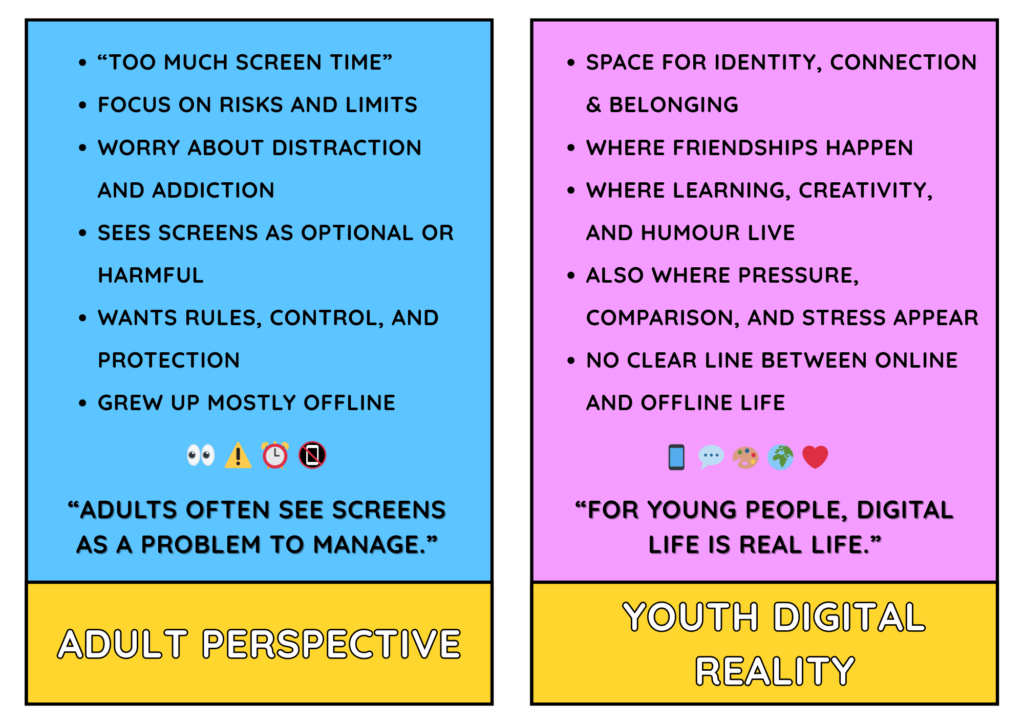
Many adults try to support young people’s digital well-being using assumptions like:
- “Screens are bad for you.”
- “You’re online too much.”
- “Just turn it off.”
But young people don’t experience digital life this way.
Their online world is:
- where friendships develop,
- where identity is explored,
- where humour, community, and creativity live,
- where belonging is negotiated,
- where pressure, comparison, and anxiety also appear.
To support them effectively, we must enter their world with curiosity rather than judgment.
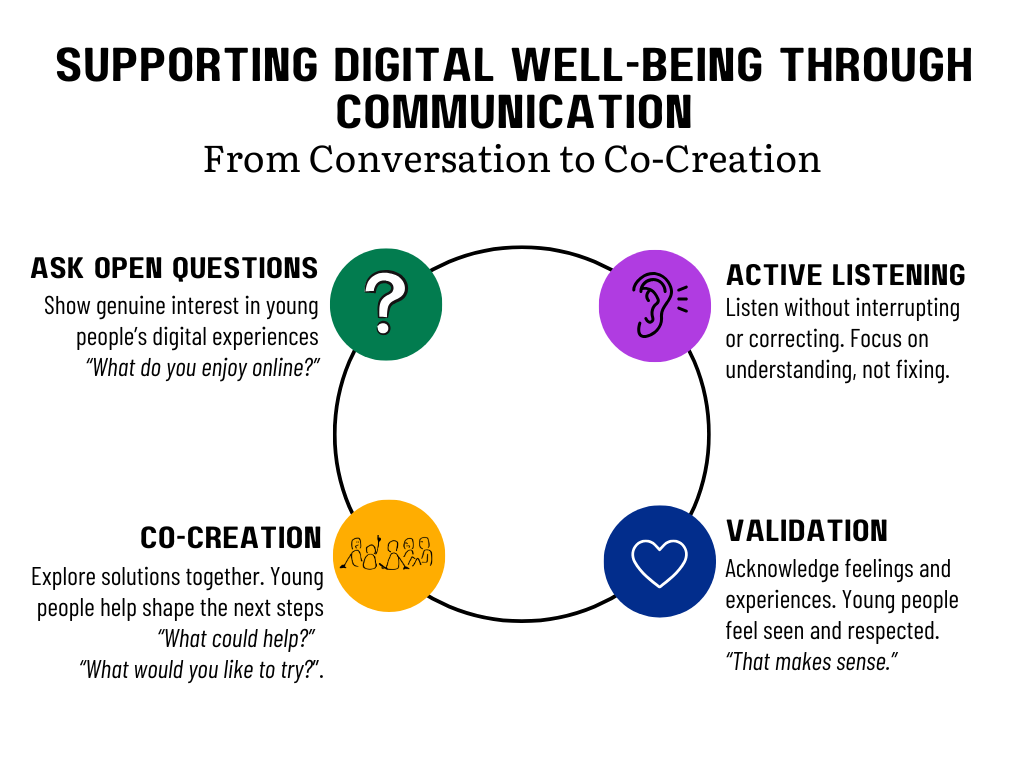
Helpful opening questions:
- “What do you enjoy most about being online?”
- “What feels stressful or draining about it?”
- “What’s something adults often misunderstand about your digital world?”
These questions signal genuine interest — not hidden criticism.
Building Trust Through Empathic Communication
Young people share honestly when they:
- feel understood
- feel respected
- believe the adult is not judging them
- know their autonomy will be respected
- see that the adult also struggles with screens sometimes
Shift from judgement → curiosity
Instead of:
❌ “Why are you always on your phone?”
Try:
✔ “What are you hoping to feel when you pick it up?”
Instead of:
❌ “You should stop scrolling so late at night.”
Try:
✔ “How do you usually feel after scrolling late? Does it help or make things harder?”
When youth feel safe, they reflect more openly.
Your Role: Guide, Not Guard
Youth don’t need someone to protect them from their devices — they need someone to walk with them as they understand their digital habits.
As a guide, you:
- ask questions instead of giving lectures
- help them notice patterns rather than telling them what to think
- support them to set their own boundaries
- celebrate small steps rather than expecting big change
- check in rather than check up
Why this works: When youth design their own solutions, they feel proud, in control, and motivated. Change becomes internal, not imposed.
Working With Resistant, Disengaged, or Defensive Groups
Some young people immediately engage when talking about digital life.Others shut down, avoid the conversation, change the subject, or make jokes to distance themselves.
Resistance is not defiance — it is a protective strategy.
Young people may resist because:
- they fear judgment or losing autonomy
- they worry adults will “take their phone away”
- digital habits help them cope with emotions they aren’t ready to discuss
- they believe adults don’t understand their online world
- they feel embarrassed, overwhelmed, or ashamed
- they simply don’t trust adults yet
- they use humour to create distance
- they don’t see their digital use as a problem
Here are practical strategies to help youth workers navigate resistance with confidence and compassion.
Start With Curiosity, Not Concern. Avoid opening with “I’m worried about your screen time.”
Use questions that signal interest, not critique:
- “What do you enjoy online?”
- “What’s something adults often misunderstand about your digital world?”
Curiosity lowers defensiveness.
Remove Judgment Early. Say it clearly: “We’re not here to take anything away — just to understand how screens fit into your life.”
This often softens resistance immediately.
Begin With Positives. If you start with problems, youth shut down.
Instead ask:
- “What online spaces feel good for you?”
- “What helps you feel connected or inspired?”
Validation opens the door to deeper conversation later.
Use Low-Risk Approaches. For youth who don’t want to share personally:
- discuss scenarios or “people your age”
- vote anonymously
- analyse fictional examples
- talk about influencers, not themselves
This keeps engagement high without exposing them.
Offer Choices. Resistance decreases when youth feel in control:
- “Do you prefer Activity A or B?”
- “Work individually or in groups?”
Use Lightness & Avoid Power Struggles. Gentle humour helps, pressure does not.
Instead of “You should stop scrolling,” try: “How do you usually feel after scrolling late — better or worse?”
Focus on reflection, not control.
Celebrate Small Wins. A resistant young person speaking once, pausing before unlocking their phone, or showing up consistently is progress.
Acknowledge it.
Empowering Youth Voice & Co-Creation
Young people are far more engaged when:
- they choose the activities,
- they set the goals,
- their experience is validated,
- their insights shape the discussion.
Practical co-creation strategies:
- Offer choices: “Which activity sounds more helpful today?”
- Invite leadership: “Who wants to facilitate the warm-up?”
- Validate lived experience: “That insight is important — thank you for sharing.”
- Reflect back: “It sounds like online connection is really meaningful to you.”
The role of the youth worker is to create an environment where youth feel safe to explore, question, and try new habits.
Modelling Balanced Digital Behaviour
Young people notice everything adults do.
If we scroll during sessions, answer messages mid-conversation, or speak negatively about our own digital habits, they internalise that.
Modelling intentionally means:
- Putting your phone away during sessions unless used for facilitation.
- Sharing your own challenges with humour and honesty.
- Showing how you set boundaries (“I turned off notifications last month — it really helped me.”)
- Demonstrating mindful check-ins before using devices in front of them.
You don’t need to be perfect. You just need to be human and intentional.
Why This Helps
Trust makes change possible. A young person will not explore their digital challenges honestly unless they feel safe, respected, and understood.
Youth autonomy increases commitment. Boundaries they choose themselves last longer than limits imposed by adults.
Modelling sets the tone. Your behaviour communicates more than any instruction.